Movie Review: The Searchers

The opening shot in “The Searchers”

Once the beginning credits were over with and John Ford’s first shot of The Searchers came into full view, I went into “holy shit!” mode.

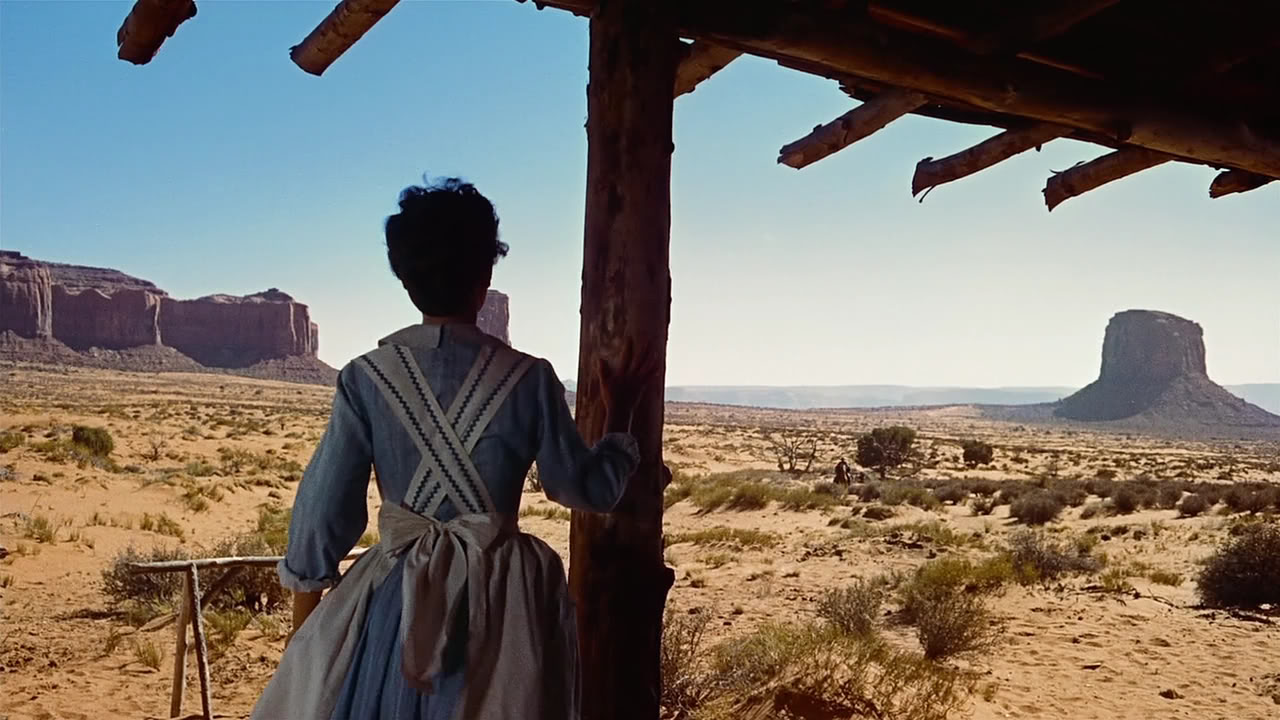
It was a simple shot, really. We begin inside a house and slowly move outside, following “Martha” as she goes out to greet the returning “Ethan Edwards” (John Wayne). It’s dark inside and what we initially see is a silhouette. Outside it’s bright enough, though, and as we go past the door Monument Valley, Arizona, is displayed in all its panoramic glory. It reminded me of the time earlier this year when I visited the Grand Canyon and was blown away by the 3D vistas (the depth of the canyon is so pronounced it felt like watching an IMAX movie in 3D). I had seen the Canyon lots of times in videos and pictures, but they didn’t do it justice, not by a long shot. It’s one of those places that you have to be there to truly appreciate it. That opening shot of The Searchers, however, came very close to that experience.

The storyline: it’s Texas, 1868. Ethan Edwards returns to his brother’s home after years of being away, first fighting in the Civil War (as a Confederate) and then… well, who the hell knows where he went those three other years, the thing is he’s back. The family is very happy to see him back, but he’s just like “meh”. Then tragedy strikes, as Comanche indians slaughter the entire family but for Edwards and “Martin Pawley” (Jeffrey Hunter), who were out searching for those Comanche, and “Debbie”, Ethan’s youngest niece who was kidnapped by the Indians (oh, shut it, I won’t be politically correct and write “Native Americans” every time). The rest of the movie is the search for Debbie, spanning several years until she’s 15. They eventually find her, of course, but what they find is not the Debbie they knew.

Martin Pawley (Jeffrey Hunter) and Ethan Edwards (John Wayne)

The Searchers is a classic, making basically all top ten Westerns lists, in some cases landing the #1 spot. I wasn’t impressed enough to make it my personal #1 Western, but it’s easily in my top ten, maybe top five. There are two reasons for that: John Wayne and John Ford.

Let’s start with Wayne. I’ll be the first to admit that, at this point in time, I haven’t seen that many John Wayne movies. I know him mostly by his reputation as the noble heroic cowboy that everyone looks forward to. His “Ethan Edwards” was anything but noble, though. He was a racist, mean motherfucker that couldn’t care less what you thought of him; for example, his nephew Martin was adopted (Martin was one eighth Cherokee), and Ethan never missed a chance to remind him both that they weren’t kin and that he had Indian blood. When Ethan’s driven – and the Comanche gave him plenty of drive – he wouldn’t stop until he got what he wanted. He had his own philosophy of life, one that wasn’t bound by incorruptible honor and gallantry, yet he does care, in his own fucked up way, about others. Wayne nailed this character through and through. I’m not surprised some consider this his finest performance, because it’s one of those that you cannot imagine being done in any other way by any other actor. Ironically, for such a great performance (and such a grand reputation for the movie as a Western and as a film in general), The Searchers received a grand total of zero Academy Award nominations.

Yeah, I guess the Oscars are overrated.

Then we have Ford. That opening shot alone made me understand why Akira Kurosawa and Sergio Leone (two of my favorite directors and two grand masters in their own right) had Ford in such high esteem and were so heavily influenced by him. What the film lacked in a strong plot more than made up for in direction, cinematography, and editing. Ford should have been nominated for an Oscar same as Wayne. The way he handled the shots made you feel like you were right there, galloping across the desert, surrounded by the Comanche, or attacking their tribe. It was brilliant, and made me wonder why most directors nowadays are so painfully… lazy. “Uncreative” would be another appropriate description, but that is mostly due to laziness and the obsessive attachment to formulaic shots and sequences. It’s like nowadays that majority of Hollywood directors are working on TV soap operas, while John Ford was working on actual Hollywood films. CGI is partly to blame, but not entirely; The Searchers looked much better than anything I have ever seen in the Western genre (Leone included), vastly – oh, oh so vastly – superior to George Lucas’ video game feel in Attack of the Clones, which had a similar red desert setting.

Speaking of George Lucas, there is a sequence in The Searchers that I’m pretty sure he… umm, borrowed for 1977’s Star Wars. As I briefly mentioned earlier, Ethan and Martin had joined a group of rangers to hunt down some Comanche that were known to be in the vicinities. Turns out the Comanche had lured the men out to attack their homes at will. They realize this and quickly return to their respective homes (well, except for Ethan, who was wise enough to allow his horse to rest before going back). What they come back to is a burnt house, and the burnt remains of the family. The sequence is very similar to the one where Luke meets Ben Kenobi and during their conversation realizes the stormtroopers would come looking for the droids at his home, where his uncle Owen and aunt Beru live. When he makes it back, all he finds are their burnt remains, with the house suffering a similar fate.

Not sure if Lucas meant that as a homage to John Ford or just decided to steal the fuck out of that sequence, but the fact that The Searchers is a major influence on so many filmmakers should come as no surprise. Ford and Wayne were at the top of their game here, and The Searchers is a movie that deserves to be seen, studied, and appreciated. It was only fitting – in fact, I was expecting it after that monumental opening – that the movie ended with a reverse shot of the first sequence, completing the circle as Ethan brings back Debbie, and then walks away.
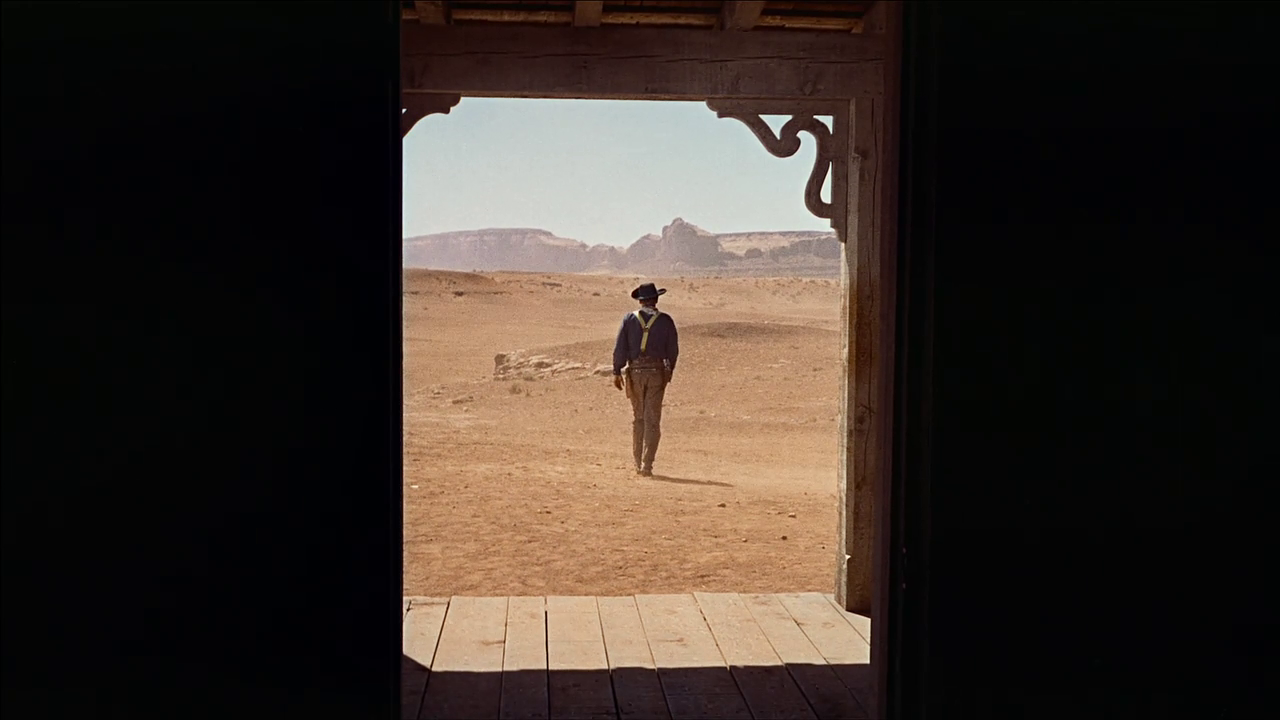
Ethan Edwards walks away, and so does the movie.

Movie Review: Battle Los Angeles

The special effects star in Battle: Los Angeles

The special effects star in Battle: Los Angeles

Note: this review was originally published on March 20, 2011

If District 9 had cornered Black Hawk Down in a dark alley, raped it, and BHD – who does not believe in abortion – eventually has a child from that horrible experience, giving it up in adoption to Independence Day, and ID4 raises that child like its own without hiding from it its past, that child would grow up to be Battle Los Angeles. Which is not necessarily, or entirely, bad.Every movie has its place in cinema; not all can be Oscar contenders in the drama categories, so movies like Battle Los Angeles have to be judged differently from, say, The King’s Speech. One has to give it some leeway in terms of plot and character development, because it is clear movies like this sacrifice those things for the sake of spectacular action. And this movie has action from beginning to end, which is good to some people and overwhelming for others. I’m in that second group. Even though I like movies that begin with a bang and keep moving, if that action doesn’t take a breather now and then to allow the story to surface, my mind starts to drift as if activating a mental screensaver and I get lost in la la land. This is something purely personal and as I said it doesn’t bother lots of other people, and in the case of Battle Los Angeles it had to be that way since the main story takes place in the span of less than a day. There’s simply no time for character development and their interactions (which is pretty much the case for life in big cities like Los Angeles now that I come to think of it).

The “plot” is simple: a small platoon of marines must try to rescue a group of civilians stuck in Santa Monica and get out before the Air Force destroys the place to wipe out the alien invaders there. The next hour and a half consists of said marines trying to escape the chaos while Los Angeles is taken by the extraterrestrials (which, I must say, are the crappiest I have seen in a long time). In the end, of course, the marines go from defense to offense and this is where you can see the influence of Battle LA’s adoptive father, with an ending that will leave Starship Troopers with a strange sense of deja vu.

The movie never tries to be original. What’s more, it never tries to cover up its lack of originality. Its mission, like the marines, is simple: entertain. And just like the marines, it accomplishes its mission, but not without some casualties along the way.

Book Review: Homeland (The Dark Elf Trilogy Book 1), by R.A. Salvatore

Several weeks ago, as I browsed for… whatever it was I was browsing at Shelfari, I came upon this blog post about author R.A. Salvatore and how he approached writing fight scenes. This interested me for several reasons, the two primary ones being that I also liked writing fight scenes and that I was starting to develop a fantasy novel at that point, so knowing Salvatore by name (even if I had never read a book of his before) I wanted to see his take on fantasy fighting scenes. I was happy to see we agreed on many points and basically approached fighting scenes in the same way, with the only difference being that he is a bestselling author and I haven’t published a single novel yet (but hey, it’s a start). As I got to the question of “What is your favorite fight scene that you’ve ever written?“, I knew I had to read those fight scenes for myself.

So congratulations, R.A. Salvatore, you have made another sale!

Thing is, I didn’t buy any of the books containing those fight scenes. All of them were showcased in books well into their own series, so buying those specific novels meant I would be lost. What’s the point of reading a fighting scene out of context? That’s like watching Transformers 3, a bunch of amazing CGI effects with no emotional context behind them to make you care, which means that no matter how great they look they’ll still be boring.

So instead I went to a good starting point in the Salvatore universe, and bought the Dark Elf Trilogy.

The Dark Elf trilogy is the origin story of Drizzt Do’Urden. Drizzt is a drow elf, meaning a subspecies of elf that lives in the Underdark. These elves are generally evil, because… well, I guess because having to use night vision 24/7 is incredibly irritating and makes you an ass. Now, I have never liked this type of generalizations regarding species or subspecies. It’s just too easy a copout, like making the entire race of Klingons in Star Trek warriors, or the entire race of Vulcans in Star Trek super smart logical beings, or basically any race ever showcased in Star Trek being all the same (except for humans, of course, because our signature trademark is our amazing diversity! Take that, rest of the Universe, hahahaha!). However, the Forgotten Realms from which these stories spawn are a series of D&D games, so for the sake of simplicity I can forgive the generalizations. Also, in this case the generalization is an important part of the story because it turns out Drizzt is one of those few drows that do not like to be evil, so he rebels against the system. Homeland covers the first thirty years or so of his life, in which he is forced to learn and embrace the ways of the drow, and ultimately abandons his people (no need for a spoiler alert, it’s not as if you couldn’t see that coming).

Even though it wasn’t a page turner and there were no amazing fight scenes (only good ones), I enjoyed it. It’s interesting to read a story about the bad guys for a change, despite the main character being a good guy at heart. It also makes for more tension, because while you know Drizzt is going to live through this book and a myriad of others, you feel for his character and what he has to go through. I mean, 99.99999% of those around him are willing to kill him if they can get away with it, his mother included (yeah, when your mother was the first one to try to kill you, you know things are bad).

Speaking of getting away with killing, that’s basically how drow society is structured. Houses – in other words, big families under one name – wage war against one another, if one perceives weakness in the target; for example, losing the favor of the Spider Queen, the deity the dark elves worship. This is done to gain a better ranking in the city, as the better the ranking, the more respect coming your way. Also, the eight highest ranked Houses comprise the council that makes the big decisions in Menzoberranzan, the drow city. In an interesting case of contradictions, obliterating another House is illegal, but only if you are caught. For that, any surviving member of the defeated House has to file a complaint to the council of eight. If you are not caught, then everyone else just turns a blind eye to the fact a House no longer exists, and secretly applauds the deed. In other words, the attacker must make sure it completely wipes out the other House, or they will be destroyed in turn by the ruling of the council. What is being punished here is not the attack but the failure to do it efficiently. Dark Elf society is structured for evil.

Another interesting aspect is how drow society is very matriarchal, where males are there only for reproduction and cannon fodder for the wars. In fact, they resemble insect societies like bees and ants, except that the drow don’t have an elf queen per se and much less would sacrifice their lives for the good of the many. It’s a nice deviation from the usual male dominated fantasy.

Will I read the next installments in the trilogy? Well, of course; I bought the three-in-one volume, so I kinda have to. But besides that, Homeland made for a good introduction into the character, almost like a teaser story, and you know it can only get better from here.

Rant: Is the U.S. the new 17th Century Church?

doublefacepalm_2-1

Some of you might know of this famous scientist who, back when the universe existed through the sheer will of God, dared to refute the claim that the Earth was the center of that universe. His name was Galileo and he was forced to recant his claims by the strongest power of the time: the Catholic Church.

The Catholic Church, however, had valid reasons to censor Galileo. Their absolute power over its subjects depended entirely on the validity (or, let’s say, literal validity) of everything that is written in the Christian Bible. There was no space for interpretation or poetic license; if one thing isn’t true, who’s to say the rest isn’t? Of course, that’s as good a justification as governments making shit up to legally invade another country. It’s been done throughout history whenever you require a large amount of people to agree blindly to your egotistical designs, so no surprises so far. And while what I will mention next should come as no surprise to anyone living outside a cave for the last twenty years or so, it’s still very disturbing.

Turns out, there’s a Canadian book on evolution that recently won a prestigious award over there for best science book for children. You guys remember when children went to school to learn the facts of life and the universe? Apparently some folks don’t, and this group has put the fear of God (literally) on U.S. publishers so that no one on American soil will pick this book up for publication. And by “this group” I mean Christian Creationist Groups.

Now, let’s be clear about something: freedom of speech goes both ways. It means that just as much as you are free to rebuke God and religion, religion can tell you that you are wrong without fear of legal reprisals; they are within their rights to defend their beliefs. However, this is nothing of the sort. This is censorship on the scale of Galileo vs. The Church, without going so far as threatening with death (as far as I know, there are always wackos). The day has come when evolution, one of the most accepted scientific theories (facts, actually) of the last century, is a topic so controversial publishing companies are bowing out from talking about it, for fear of the Creationism faction.

I wonder what would be the public’s response if the roles were reversed and it was the scientific community trying to bury forever and without question the religious beliefs of this people, using their clout to achieve their ends. Yeah, I can already see Apple, Google, and Microsoft threatening with an embargo of their products if the U.S. Government doesn’t outlaw Bibles. Or maybe Bill Nye the Science Guy putting Creationism in its place.

The religious rhetoric in a supposedly secular state such as the United States has been alarmingly going on the rise for the last few years; at least it caught my attention since the Bush Jr. administration (I’m the first one to admit I don’t pay much attention to politics, most probably it’s been going on since way before that). It’s alarming because, historically, one of religion’s staunchest characteristics is its intolerance. Its “we are right and you are wrong, and you will pay for your mistake in Hell” mentality is eerily similar to Bush’s “you are either with us or against us” rhetoric. The values that once made the U.S. a promising nation are giving way to the censorship and oppression of the “1984” world.

And that, folks, is one scary thought.